
|
Welcome to a brand of
Mathematical
Services. 2026-11-12 09:37:39 - Paul D. Foy - Leeds I think this post or comment could sit equally well under one of the posts I did two years ago, which was on British values. As you know I live in Bradford and I do know quite a bit about the history and the working conditions of men, women, and children in the mills and factories in Bradford. I feel I've got some knowledge and competence and can speak with a sort of reasonable authority on that because I've lived here. I know the place, etc. I've lived in Birkenshaw, actually, just outside of Bradford, but it's very close. It's a similar philosophy. There have been mills in Birkenshaw as well. I attended a talk the other day in Leeds about the health conditions of children working in the factory trades and mills of Leeds. It was a bit of an eye-opener to me because I realised that Leeds was not dissimilar to Bradford. It had a lot of poor sanitary housing, slums, open sewers, nowhere to live, crowded abodes, and lots of injuries, malnutrition, and deformities at work amongst young people, this kind of thing. I thought, well this is very similar to Bradford. Perhaps it's very similar in a lot of northern cities: Manchester, Liverpool, Birmingham, and even others in West Yorkshire. Perhaps it's similar there: Huddersfield, Wakefield, Halifax. I think this thing is fairly common and we have a very common past. It certainly piqued a new interest in Leeds and I might look a bit deeper into it: how these conditions unfolded in Leeds as opposed to Bradford, what the motivation factors were there, and what the differences were there. It's a bit of an interest to be going on with but I'll leave you with another comment which I found very insightful from a representative of the situation at the time. Money was the only important thing, and money, for the owner of the mill and the factory, was everything. Nothing else much counted. The mill owners lived very lavish lifestyles: big houses, lots of land, lots of space. They just didn't live lavish lives. They also died quite splendidly as well. For example there's a cemetery in Leeds, the Woodhouse Cemetery, Leeds General Cemetery, it's called. I've given a plaque from the cemetery in the comment. Apparently you weren't the same in life and you weren't the same in death either because the rich had very grandiose graveyards, like they do in Bradford, the Undercliff Cemetery, for example. They were buried nearer to the chapel or mausoleum, the grand structure there. The paths leading to the chapel or the mausoleum were paved with the gravestones of the poor, who you walked along to view your grave. I thought that was quite interesting. 2026-11-12 09:39:56 - Paul D. Foy - Here is the picture of the plaque of Leeds General Cemetery, mentioned in the opening post. It's in the area of the University of Leeds and I believe now it's a public park. It's quite an interesting place. It's probably analogous to Undercliffe Cemetery in Bradford, where the 'worthies' of the two places were buried. 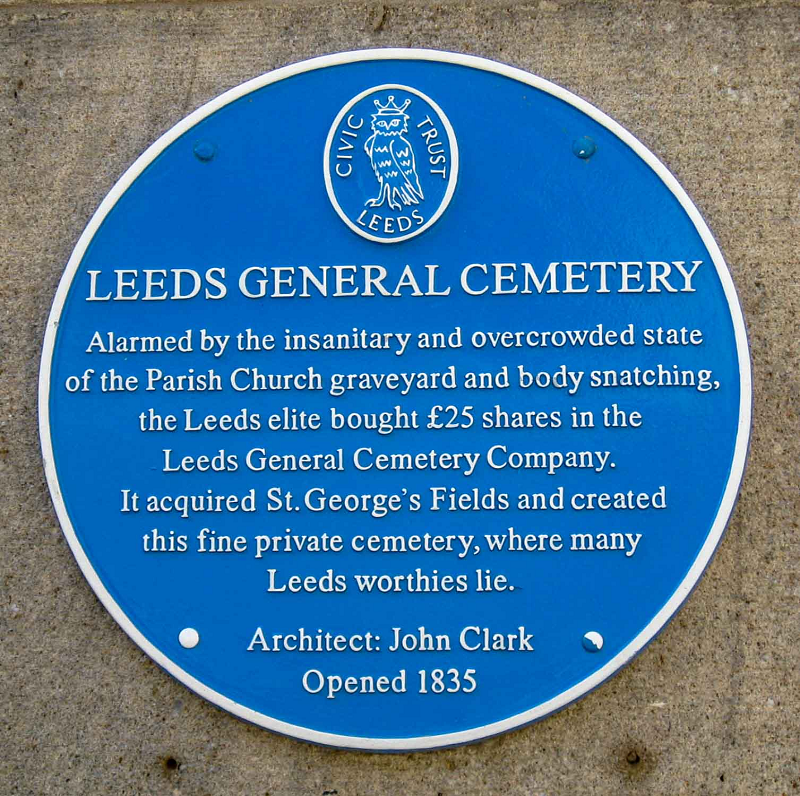 Post a comment: |